Why Your Budget Keeps Failing (Even When You’re Doing Everything Right).
The problem isn’t your discipline—it’s that you’re using the wrong map.

Ever started strong with tracking and categories, only to find your spreadsheet in the red three months later?.
You reconcile every receipt and follow every rule, yet your goals aren’t getting any closer .
The Truth: Most budgets fail because they obsess over “this month’s” details while ignoring the “long-term” trajectory.
Budgeting isn’t a rigid formula; it’s a map that must evolve as your life changes.

Why divide into Scenarios?
Generic financial advice assumes everyone faces the same constraints. In reality, a person fighting debt needs different data than someone managing a global portfolio. Using the wrong “Scenario” map leads to the Effort Trap: maximum discipline with zero results.
Quick Selector: Identify Your Map
Select the statement that matches your current life to jump directly to your solution
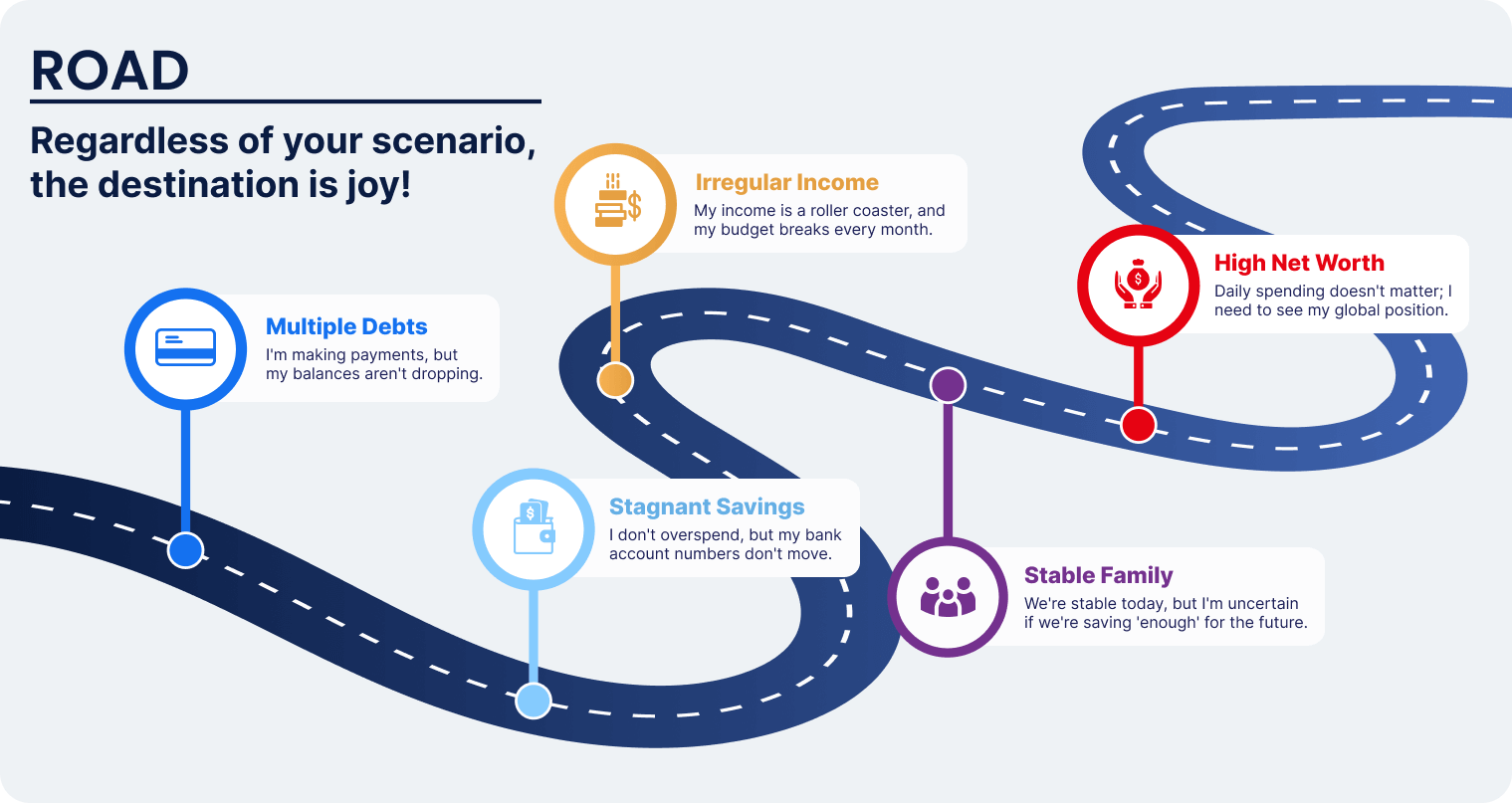
The Five Financial Life Scenarios
Scenario 1
Multiple Debts — You Need an “Exit,” Not Restrictions
Core pain
You cut expenses and stay disciplined, but the balance won’t move.
What works
Goal-Based Budgeting
Key idea
Set a finish line. Track repayment trajectory, not daily guilt.
Rule
your future asset projection should never drop below zero.


Scenario 2
Stagnant Savings — You Need “Trajectory,” Not “Transactions”
Core pain
You’re not reckless, but savings barely grow.
What works
The Two-Layer System
Key idea
Being “under budget” doesn’t mean you’re “on track.”
Budget
Budget = short-term control. Saving goals = long-term strategy.
Scenario 3
Irregular Income — You Need “Absorption,” Not “Stability”
Core pain
Monthly budgets fail because they force fake stability on real volatility.
What works
Spending Floor + Annual Goal System
Key idea
Set a spending floor for safety + an annual saving target for absorption.Good months push you ahead. Slow months slow you down—without breaking the plan.

Scenario 4
Stable Family — You Need “Perspective,” Not “Perfection”
Core pain
Bills are fine today, but you fear your “stable pace” is too slow for retirement.
What works
Key idea
Detailed tracking becomes noise. Confirm your net worth trajectory.
Monthly check
Is growth pace enough for education/retirement gaps?
Scenario 5
High Net Worth — You Need “Positioning,” Not “Monitoring”
Core pain
Daily spending doesn’t move the needle—asset structure does.
Cross-country, multi-currency assets make auto-sync inconsistent and noisy.
What works
Position Awareness
Key idea
Identify growth engines vs stabilizers vs silent drags
Set a base currency anchor
Use snapshots (monthly/quarterly), especially for illiquid assets (real estate, equity)
Psychological payoff
Orientation removes urgency—you hold wealth instead of chasing noise.