
From Net Worth to Asset Value, Profit & Loss, and Position — Using Vision Money
At a certain level of wealth, financial tracking stops being about effort.
It becomes about orientation.
Most high net worth individuals already feel this shift — often unconsciously.
They no longer worry about budgeting.
They no longer question daily spending decisions.
They no longer rely on alerts, categories, or monthly limits.
And yet, despite having more resources than ever, many feel a subtle form of confusion:
“I know I’m wealthy — but I don’t always know why my wealth changes.”
This is not a discipline problem.
It is a visibility problem.
Vision Money is built specifically for this stage — where wealth is no longer something to control, but something to understand.
When Budgeting Stops Explaining Reality
Budgeting works when spending behavior determines outcomes.
Early in life:
- Overspending causes failure
- Discipline creates stability
At high net worth, this logic breaks.
Daily spending does not change trajectory.
Asset structure does.
That is why traditional budgeting quietly disappears from the mental model of wealthy individuals — not because it is “bad,” but because it stops answering meaningful questions.
The questions that replace it are different:
- Where is my wealth positioned today?
- Which assets are actually growing my net worth?
- Which assets are volatile, but ultimately irrelevant?
- Which assets are silently losing value without my attention?
These are not budgeting questions.
They are position questions.
Why Net Worth Is the Starting Point — Not the Answer
Net worth remains essential.
Net Worth = Total Assets – Total Liabilities.
But at high net worth, net worth alone becomes opaque.
Two portfolios can show the same net worth and behave completely differently over time:
- One compounds through productive assets
- One drifts through market noise
Without understanding how net worth changes, the number loses explanatory power.
High net worth individuals don’t just want to see the number.
They want to know:
“What actually caused this change?”
That requires tracking asset value and profit & loss, not just totals.
Step 1 — Establish a Primary (Base) Currency to Anchor Reality
Once wealth becomes global, currency becomes unavoidable.
High net worth individuals commonly hold:
- USD brokerage accounts
- EUR or GBP real estate
- Local operating businesses
- Crypto in native denominations
Vision Money begins by setting a Primary (Base) Currency.
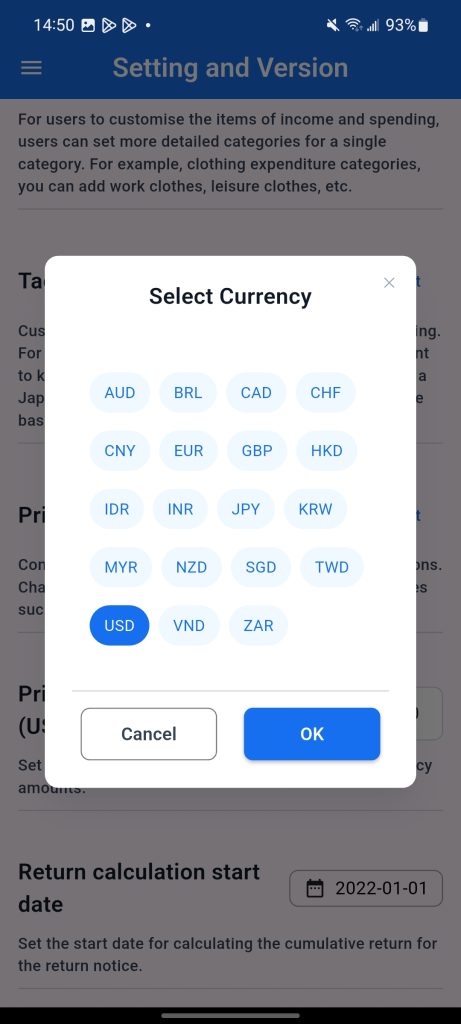
This does not eliminate currency diversity.
It creates a single reference frame.
- Assets retain native currency
- Reports consolidate into one base currency
- Net worth becomes comparable over time
Without a base currency, wealth fragments.
With it, position becomes visible.
Step 2 — Every Asset Is an Account, Even When It Doesn’t Trade
At high net worth, many important assets do not update automatically:
- Real estate
- Private equity
- Pre-IPO shares
- Long-term strategic holdings
Vision Money does not force these assets into transaction-based logic.
Instead, each asset is treated as an Account.
Each account defines:
- Initial value
- Valuation currency
- Independent valuation rhythm
This mirrors how wealthy individuals already think:
“This is one position. I want to understand its contribution.”
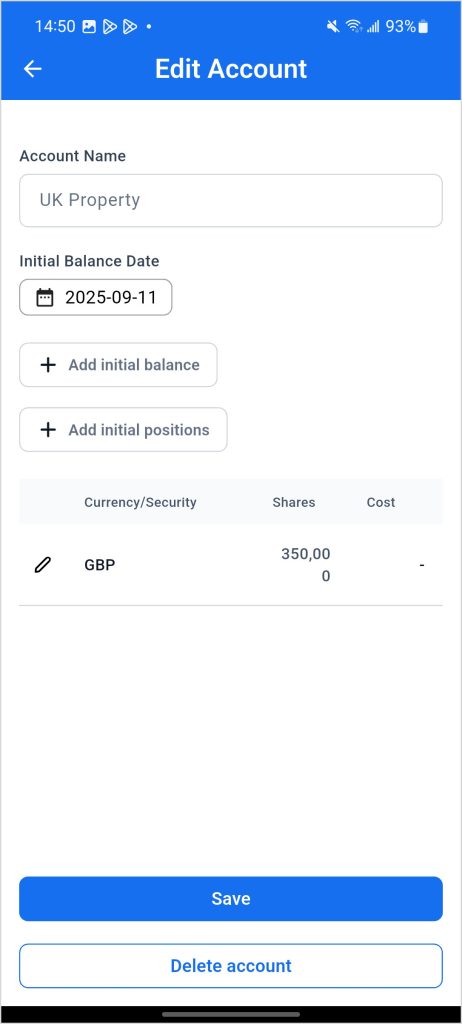
There is no need to invent fake transactions.
There is no need to pretend liquidity exists.
Step 3 — Adjust Captures Valuation, Not Activity
Illiquid assets do not change value because you did something.
They change value because reality changed.
Vision Money uses Adjust transactions to record valuation:
- You choose a valuation date
- You enter the updated value
- The system calculates appreciation or depreciation
This creates a historical valuation timeline without distorting behavior.
Adjust is not trading.
It is position recording.
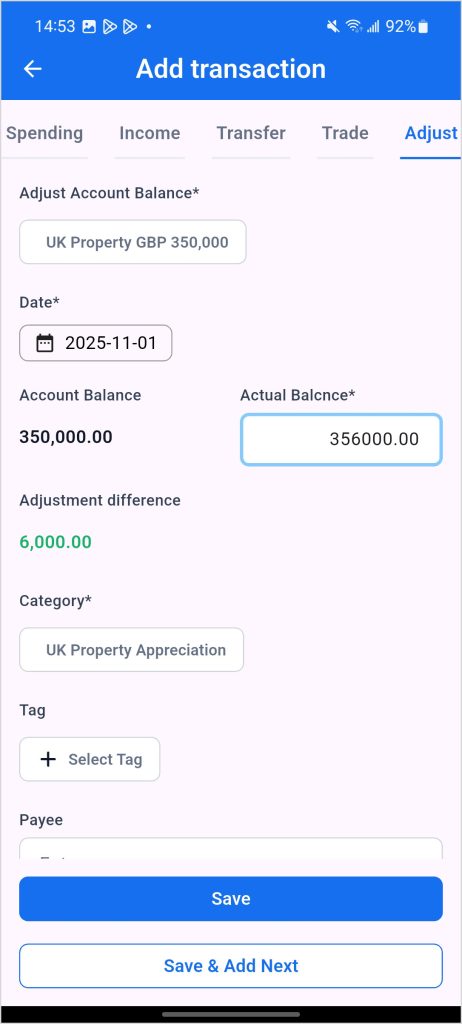
This distinction is critical at high net worth.
Step 4 — Cash Uses Balance-Based Tracking, Not Transaction Obsession
This is one of the most important conceptual shifts.
At high net worth, cash is not a behavioral problem.
It is a position component.
Tracking every cash inflow and outflow creates noise:
- Endless movement
- Minimal insight
- Constant distraction
Vision Money applies Balance-Based Tracking to cash accounts.
Instead of asking:
“What moved today?”
You ask:
- What is my current balance?
- How has it changed since the last snapshot?
- Does this align with my overall wealth trajectory?
Cash can be:
- Updated via transactions when detail matters
- Adjusted directly when accuracy matters more than history
This reflects how high net worth individuals actually treat cash:
Cash is something to confirm — not something to manage daily.
Balance-Based Tracking keeps cash visible without letting it dominate attention.
Step 5 — From Net Worth to Profit & Loss (P/L)
At this stage, net worth alone is not enough.
High net worth individuals still care deeply about:
- Which assets made money
- Which assets lost money
- Which assets deserve more or less capital
This is where Profit & Loss (P/L) comes in.
P/L simply means:
How much value increased or decreased — and where it came from.

Vision Money allows value changes to be categorized:
- Asset appreciation
- Investment gains
- Income-like growth
- Losses or write-downs
This allows reports to answer:
- Which assets are driving growth?
- Which assets are drag?
- Is my net worth growing structurally, or just fluctuating?
Unlike spreadsheets, this logic remains stable across:
- Currencies
- Illiquid assets
- Long time horizons
Step 6 — Investment Accounts Track Inventory, Cost, and Performance
For tradable assets, Vision Money switches logic — seamlessly.
Investment accounts support:
- Initial inventory and cost basis
- Trade transactions (buy, sell, dividends)
- Realized and unrealized P/L
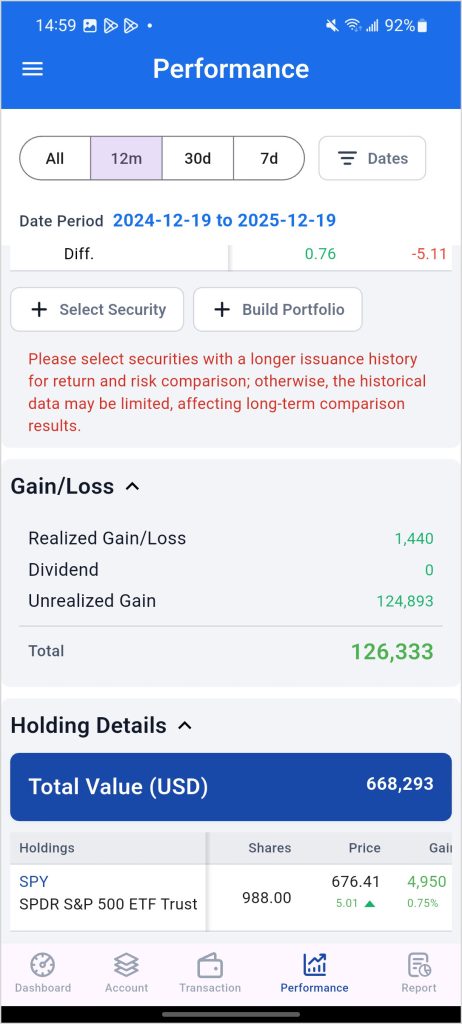
This allows you to see:
- True performance
- Capital efficiency
- Risk vs contribution
Again, the focus is not activity.
It is position quality.
Step 7 — Dashboard Shows Trajectory, Not Noise
Once assets are structured correctly, the Dashboard changes character.
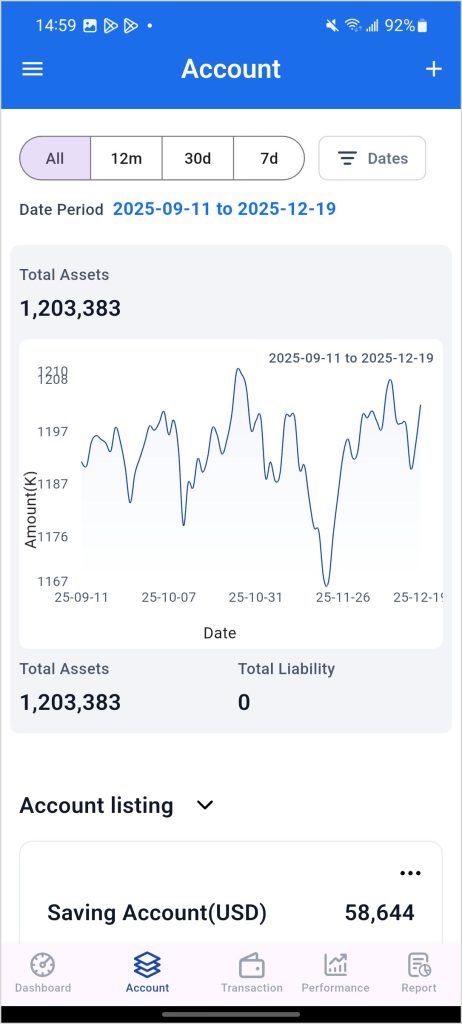
Instead of alerts and transactions, it shows:
- Total asset value over time
- Net worth trajectory
- Asset composition and balance
This is not a trading interface.
It is a position overview.
High net worth individuals do not need stimulation.
They need confirmation.
Step 8 — Reports Answer Structural Questions
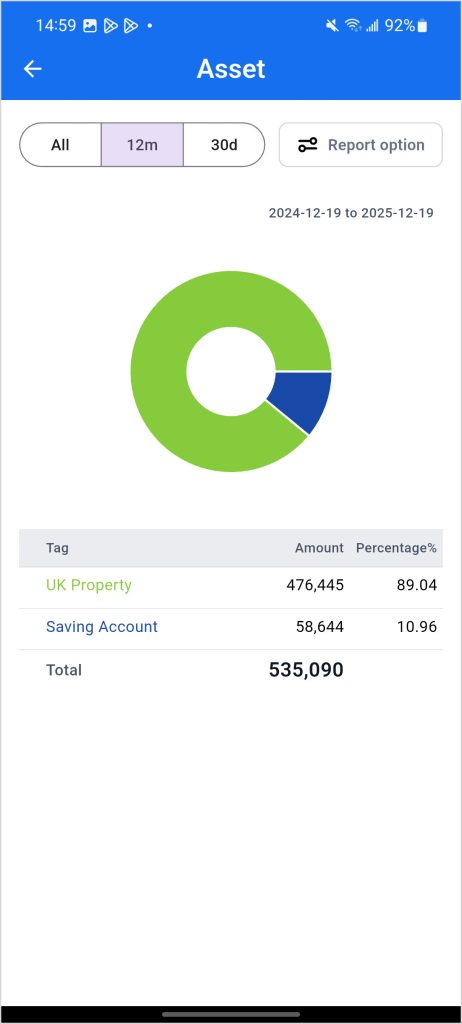
Vision Money reports are designed to answer questions like:
- Where is my wealth concentrated?
- Which assets generate returns?
- Which assets stabilize risk?
- How has my structure evolved over time?
This is not accounting.
It is orientation.
Why This Works When Other Tools Feel Fragile
Most financial tools assume:
- More automation = better insight
- More data = better decisions
- Real-time updates = better control
High net worth reality proves the opposite.
Vision Money is built on different principles:
- Balance over transactions
- Structure over detail
- Snapshots over noise
That is why it aligns with how wealth actually behaves at scale.
Final Thought — From Tracking Money to Understanding Wealth
High net worth individuals do not track money to control behavior.
They track wealth to maintain clarity.
Vision Money does not push activity.
It preserves truth.
You decide:
- When to evaluate
- What matters
- How often to look
The system ensures that when you do look,
you see your real position — across assets, currencies, profit & loss, and time.
That is the difference between knowing your net worth
and truly understanding your wealth.